
Medicare Prescription Drug Plans: Understand Your Options Before You Enroll
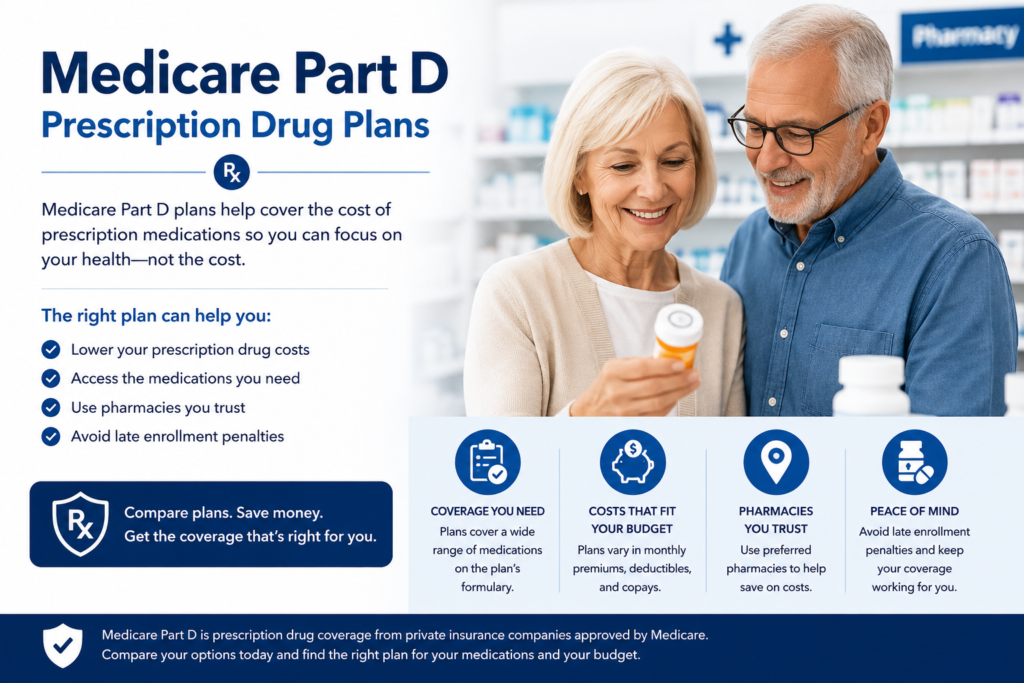
Medicare Part D is prescription drug coverage available through private insurance companies approved by Medicare.
These plans help cover the cost of many prescription medications and can be purchased as a standalone plan alongside Original Medicare or included with many Medicare Advantage plans.
Choosing the right Part D plan is important because prescription coverage, pharmacy networks, premiums, and drug costs can vary significantly from one plan to another.
Medicare Part D is prescription drug coverage designed to help Medicare beneficiaries pay for covered medications.
Part D plans are offered by private insurance companies that contract with Medicare.
Coverage is available to individuals enrolled in Medicare and can help reduce prescription drug costs throughout the year.
Important Things to Know
Each Medicare Part D plan has a list of covered medications called a formulary.
A formulary is the plan’s list of drugs that may be covered and how they are categorized.
Most plans organize medications into different tiers.
Generally:
Your total prescription costs can depend on:
If you go without creditable prescription drug coverage for an extended period after becoming eligible for Medicare, a late enrollment penalty may apply.
This penalty can increase your prescription drug costs if you enroll later.
Because the penalty can remain with you for as long as you have Part D coverage, many individuals choose to maintain prescription drug coverage even if they currently take few medications.
| Cost Type | What It Means |
|---|---|
| Monthly Premium | Amount paid each month for coverage |
| Annual Deductible | Amount paid before certain drug benefits begin |
| Copayment | Fixed amount paid for prescriptions |
| Coinsurance | Percentage of drug cost paid by the member |
| Formulary Tier | Drug category that determines cost-sharing |
| Pharmacy Network | Pharmacies where plan pricing applies |
Most Medicare Part D plans place medications into tiers.
Drug tiers vary by insurance company and plan.
| Drug Tier | Typical Cost Level |
|---|---|
| Tier 1 | Lowest Cost Generic Drugs |
| Tier 2 | Preferred Generic Drugs |
| Tier 3 | Preferred Brand Name Drugs |
| Tier 4 | Non-Preferred Brand Name Drugs |
| Tier 5 | Specialty Medications |
You can enroll in or change Medicare Part D prescription drug plans during certain enrollment periods. Understanding these windows can help you avoid missed deadlines and possible late enrollment penalties.
This is your first opportunity to enroll in a Medicare Part D plan when you become eligible for Medicare.
This is when most Medicare beneficiaries review, compare, and change prescription drug plans for the upcoming year.
Certain life events, such as moving or losing other coverage, may create additional opportunities to enroll in or change a Part D plan.
Medicare Part D is prescription drug coverage offered through private insurance companies approved by Medicare.
Many individuals still enroll because waiting may result in a late enrollment penalty later.
Yes. Changes can generally be made during eligible enrollment periods.
No. Each plan has its own formulary and list of covered medications.
A formulary is a plan’s list of covered prescription medications.
Not always. Most plans have pharmacy networks with preferred and standard pharmacy options.
You may have alternative medications available, or you may be able to request a coverage determination depending on the situation.
Possibly. Depending on your situation, medical underwriting may be required.
Mission Essential Insurance can help you compare Medicare Part D plans available in your area, review your medications, and identify options that may fit your healthcare needs and budget.

We are ready to find the best insurance quote for you
Please submit a request by using the form below. We’ll contact you as soon as possible.